A compressor selected from horsepower alone can deliver the wrong flow, pressure, air quality or operating cost for your plant. By matching equipment to measured demand, process conditions and support requirements, you can compare suppliers on useful capacity, reliability and total ownership cost.
Key takeaways
- Measure base load, peak flow, shift changes, and pressure at the farthest point.
- Match compressor capacity and controls to your plant’s duty cycle.
- Add dryers, filters, and drains when moisture or contamination threatens production.
- Compare service response, commissioning records, energy data, and spare-parts support.
How do you calculate the air capacity and pressure your plant actually needs?
Start with a compressed air demand profile, not a compressor catalogue. Record base load, peak flow, shift changes, and pressure at the most demanding point during representative production periods; a single instantaneous flow reading is not enough.
For a CFM calculation or m³/min calculation, add simultaneous tool and machine demand, measured leakage, and a defined allowance for planned expansion. Do not add every connected nameplate rating because equipment rarely runs together.
Express capacity as free air delivery (FAD) in CFM or m³/min at a stated discharge pressure and inlet condition. Treat free air delivery (FAD) versus displacement as a critical comparison: displacement and inlet volume do not represent usable delivered air.
| Figure | What it represents | How to use it |
|---|---|---|
| Free air delivery (FAD) | Usable flow at stated pressure and inlet conditions | Compare compressors on the same test basis |
| Displacement | Theoretical swept volume | Do not use it as delivered capacity |
| Inlet volume | Air entering the compressor | Do not compare it with FAD |
Specify pressure at the point of use, then measure losses through the dryer, filters, separator, piping, hose and regulator. Raising discharge pressure to hide those losses increases energy use and leakage.
- FAD at the required pressure and inlet condition.
- Pressure loss across each air-treatment and distribution component.
- Receiver volume, pressure recovery time and expected pressure band.
A receiver covers short peaks and reduces cycling; it cannot replace compressor capacity during sustained demand.
Which compressor type and control strategy fit the duty cycle?
A rotary screw compressor fits continuous or high-duty industrial demand, but its control method must match the demand profile. Use a fixed-speed compressor for a steady base load near its efficient operating range; use a VFD when flow changes substantially across shifts.
| Option | Best fit | Main limitation |
|---|---|---|
| Fixed-speed compressor | Stable demand near one operating point | Inefficient unloaded running when demand falls |
| VFD compressor | Wide, sustained demand variation within its specified control range | Added drive losses and complexity |
| Reciprocating compressor | Intermittent, low-duty work and smaller air volumes | Continuous operation causes heat, valve wear and shorter service life |
Good VFD compressor selection excludes near-constant loads, frequent rapid cycling and operation outside the compressor’s or drive’s control limits. A VFD is not automatically the lowest-energy choice, especially near full load.
A sequenced base-load and trim arrangement can outperform one premium machine. Ask the supplier to model unloaded running, minimum stable output, pressure-band settings and compressor sequencing.
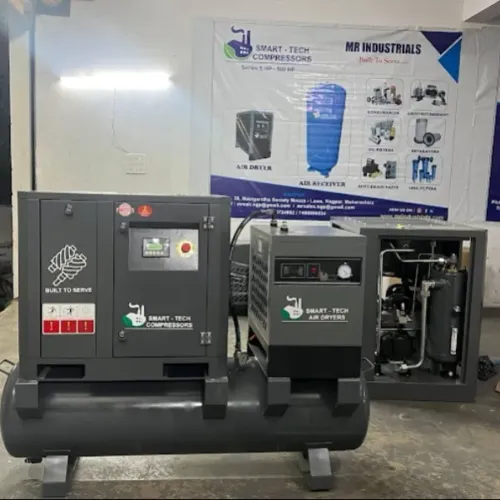
Judge capacity by measured free air delivery, or FAD, at the stated pressure and reference conditions—not by horsepower. For a 10 HP tank-mounted package serving a packaging line, compare documented peak FAD and pressure performance with measured line demand, duty cycle and planned expansion.
The package fails if its receiver only covers a short peak while sustained demand exceeds compressor output.
When is a tank-mounted package enough, and when do you need a complete air-treatment train?
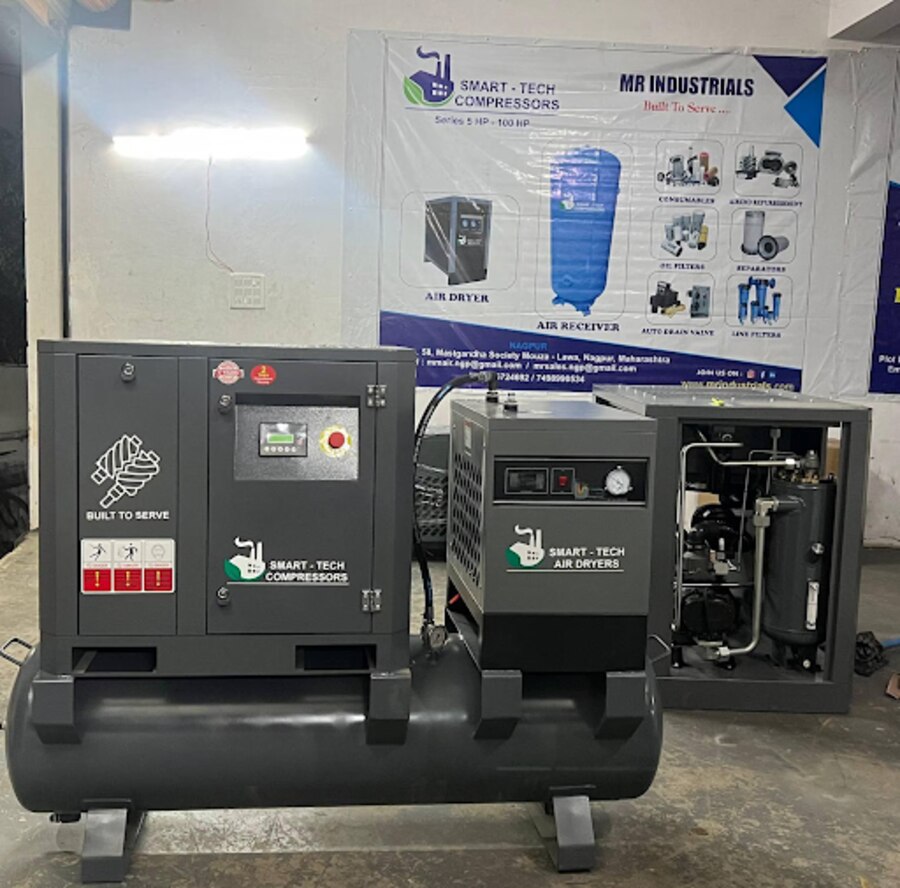
A tank-mounted compressor package is enough when one machine, its receiver and standard treatment meet your measured demand and air-quality class. It reduces floor space, installation work and separate connections. Before approving it, check receiver volume, pressure-vessel compliance, service clearances, dryer position, cooling capacity and condensate handling.
| Option | Strength | Check before choosing |
|---|---|---|
| Tank-mounted compressor package | Compact installation with fewer connections | Receiver volume, vessel code, access, cooling, drains and future capacity |
| Separate receiver, compressor, dryer and filters | Easier access and flexible expansion, redundancy and process treatment | Extra floor space, piping, valves and installation work |
Specify “clean air” as ISO 8573-1 classes for particles, water and oil. General plant air, instrument air, packaging, food, pharmaceutical, electronics and paint spraying do not share one purity requirement. Confirm whether the compressor is oil-injected or oil-free, then specify coalescing filters, particulate filters, activated-carbon filtration or an oil-free design when the process demands it.
Size the dryer from flow, inlet pressure, inlet temperature, ambient temperature and required pressure dew point. A refrigerated air dryer near +3 °C suits many plant applications.
A desiccant dryer around −40 °C belongs where a lower dew point is necessary; account for desiccant dryer purge air because regeneration consumes compressed air and cuts net available capacity. The compressor alone is not an air-quality solution.
How should you compare an air compressor manufacturer’s claims and support?
Do not compare compressor horsepower or catalogue inlet volume. Request a like-for-like schedule with FAD at the same discharge pressure, reference conditions and test convention.
| Item | Request in writing | Why it matters |
|---|---|---|
| FAD and efficiency | FAD, specific power kW per m³/min, motor-efficiency class | Reveals usable output and energy demand |
| Operating fit | Sound level and control range | Shows whether the machine suits the site and load swings |
| Support | Service intervals and spare-parts availability | Exposes maintenance delays and production risk |
| Cost | Total cost of ownership, including electricity, installation, commissioning, preventive maintenance, condensate disposal and likely downtime | Prevents a low purchase price from hiding higher operating costs |
Treat “breakdown free,” “long life” and “fast service” as claims until the supplier defines the test basis, response time, exclusions and service-level terms. Ask whether parts are stocked locally, which components have quoted lead times and who responds outside normal working hours.
For a stated five-year air-end and motor warranty, ask which models qualify, whether labour and parts are covered, which failures are excluded, what commissioning conditions apply and which maintenance records preserve cover. These compressor warranty exclusions can outweigh the headline warranty period.
SMART - TECH COMPRESSORS can support a real compressor manufacturer comparison when it provides written FAD data, efficiency figures, control range, service schedule, parts policy and warranty terms. A longer warranty has little value if undocumented conditions apply or installation labour remains outside coverage.
Related products
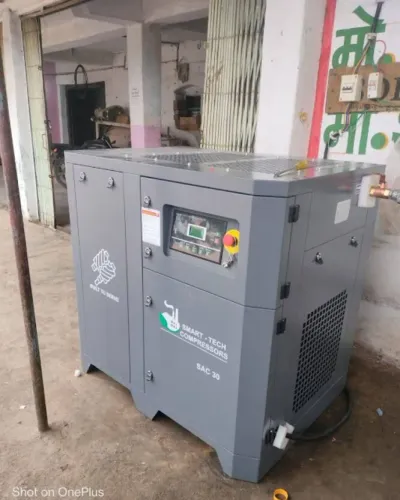
 | Tank Mounted 10HP TANK MOUNTED MODEL FOR PACKAGING INDUSTRIES Tank mounted complete package rotary screw air compressor specially built for small industries with affordable prices and service. |
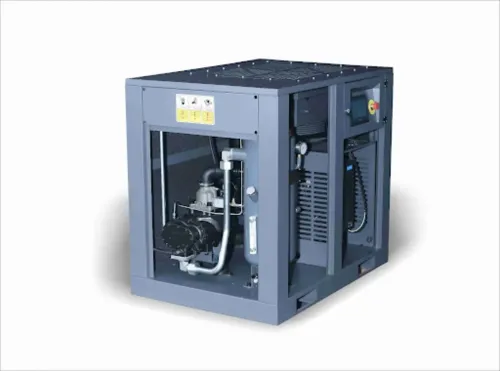
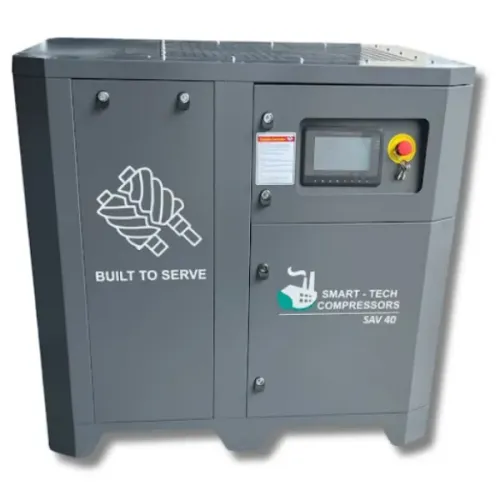
 | Rotary Screw Air Compressor Smart -Tech Compressors Upto 300 HP We brought Special customised machine for customers , very cost effective and breakdown free , long life with energy saving and low maintenance... |
What commissioning and service plan keeps the system reliable?
Commissioning should start with a documented site survey, not delivery of the compressor. Require checks of the load profile, electrical supply, ventilation, foundation, piping, receiver sizing, dryer selection and acceptance testing. In hot, dusty locations such as Nagpur, confirm inlet filtration, cooler-cleaning access, ventilation capacity, ambient-temperature derating and electrical protection before installation.
| Arrangement | Choice | Check before approval |
|---|---|---|
| High discharge | Directs condensate away from the work area | Confirm the outlet cannot create an exposure, drainage or environmental problem |
| Low discharge | Shorter route to a safe collection point | Provide containment and prevent floor contamination |
| Timed drain | Opens on a schedule | Incorrect intervals either waste air or leave condensate behind |
| Zero-loss drain | Opens when condensate is present | Check the strainer, power supply, alarm and fault operation |
Fit an automatic drain valve at the receiver, filters and dryers wherever condensate collects. Base servicing on operating hours and site conditions: change oil and filters, replace separators, inspect belts or couplings, clean coolers, remove moisture, test controller alarms and perform a compressed air leak survey. Verify repairs with pressure-decay or flow checks.
Define lead and standby compressor redundancy, bypass arrangements and remote alarms; ask whether the remaining machine can hold required point-of-use pressure after one compressor fails.
Frequently asked questions
How do you calculate the air capacity and pressure your plant actually needs?
Build a demand profile from representative production periods. Record base load, peak flow, shift changes, and pressure at the most demanding point rather than relying on one instantaneous flow reading.
Which compressor type and control strategy fit the duty cycle?
Use a rotary screw compressor for sustained industrial demand, a reciprocating compressor for intermittent or lower-volume duty, and select fixed-speed or variable-speed control according to how widely demand changes.
When is a tank-mounted package enough, and when do you need a complete air-treatment train?
A tank-mounted package can suit a compact application with modest, clean-air requirements. Add an air receiver, dryer, filters, and automatic drains when moisture, oil, particles, or fluctuating demand could affect equipment or product quality.
How should you compare an air compressor manufacturer’s claims and support?
Request documented flow and pressure conditions, power consumption, warranty terms, service response times, spare-parts availability, installation scope, and references for comparable industrial duty.
What commissioning and service plan keeps the system reliable?
Require leak checks, pressure verification at the point of use, control testing, drain operation checks, commissioning records, maintenance intervals, and a clear escalation process for breakdowns.
Related products
 | Rotary Screw Air Compressor Smart -Tech Make 30 HP Fix Speed Compressor ₹310000 Smart -Tech compressors braught a customised machine for customers very good in Quality , low cost , energy saving , low maintenance cost , fast... |
 | Rotary Screw Air Compressor SMART -TECH MAKE 25 HP VFD COMPRESSOR ₹380000 Smart -Tech compressors braught a customised machine for customers very good in Quality , low cost , energy saving , low maintenance cost , fast... |
 | Rotary Screw Air Compressors braught a customised machine for customers very good in Quality , low cost , energy saving , low maintenance cost , fast service availability , and 5... View product → |
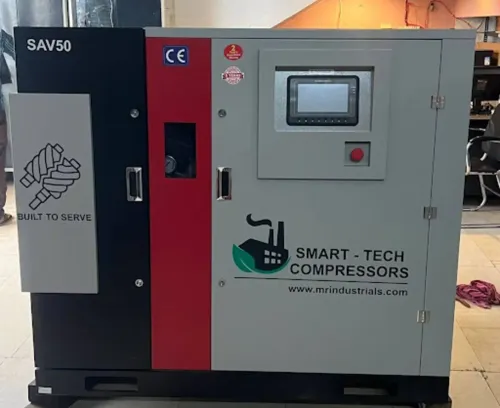
 | Rotary Screw Air Compressor 50HP SMART -TECH VFD COMPRESSOR PREMIUM MODEL PREMIUM RANGE ROTARY SCREW AIR COMPRESSOR 50HP VFD MODEL WITH VERY AFFORDABLE PRICE AND MORE WARRANTY THAN ANY BRAND |