A compressor sized from connected-tool nameplates can be too small during production peaks and wasteful during quiet periods. By the end, you will be able to turn measured flow, pressure, storage, leakage, and operating conditions into a defensible capacity specification for a compressor supplier.
Key takeaways
- Log flow, pressure, compressor status, and machine operation before sizing capacity.
- Add every filter, dryer, pipe, valve, and elevation pressure loss to working pressure.
- Choose fixed-speed, VFD, or sequenced compressors from measured load variation.
- Use receiver volume for brief demand peaks instead of oversizing the compressor.
Build a Capacity Calculation From Measured Plant Demand
Start with a demand survey, not the sum of every machine’s air-consumption nameplate. Build the plant air demand profile using 1–5 minute logging intervals for system flow, header pressure, receiver pressure, compressor loading and unloading, and simultaneous machine operation.
Cover every shift, startup, break, cleaning period, and nonproduction period. Run the survey for at least one week when demand varies. Record the average flow, each peak flow, and how long each peak lasts; a ten-second blow-off and a ten-minute production load require different solutions.
Use free air delivery, or FAD, measured at the specified discharge pressure and stated inlet reference conditions. Motor horsepower, swept volume, and advertised nominal CFM are not capacity measures: two compressors with the same motor rating can deliver different FAD.
Include these inputs in the compressor capacity calculation:
- Measured production flow
- Measured leakage flow
- Genuine future production demand tied to a confirmed machine, line, or schedule
- The duty cycle of each selected compressor
- Peak duration and the ability of storage or sequencing to cover it
Leakage is production demand. A poorly maintained plant can lose roughly 20–30% of compressor output through leaks, so repairing leaks may reduce the capacity you need to install.
Calculate required installed FAD from production flow, leak flow, future demand, and machine duty cycle. Do not size from the largest instantaneous reading until you establish whether receiver storage or sequencing can cover that peak; otherwise, you can buy an oversized compressor that remains lightly loaded.
Set Working Pressure After Accounting for Every Pressure Loss
Set compressor discharge pressure equal to the required working pressure at the machine plus every pressure drop between that machine and the compressor. A machine needing 90 psi at its inlet does not receive 90 psi from a compressor set to 90 psi if the distribution system loses 12 psi.
Use this checklist for each critical point of use:
- Record the machine’s required inlet pressure under full operating flow.
- Measure or obtain the pressure drop across the aftercooler, refrigerated or desiccant dryer, coalescing filter, particulate filter, piping, hose, regulator, quick coupler, and production equipment.
- Recheck filters after service intervals. A filter that was clean at commissioning can become a major restriction as it loads with oil or dirt.
- Correct the restriction instead of raising the whole header to compensate for an undersized hose or blocked filter.
- Allow for roughly 1% more compressor power for every 2 psi increase in discharge pressure across the typical industrial range. The actual penalty depends on the compressor and operating point.
- State point-of-use air quality as an ISO 8573-1 class for particles, water, and oil. “Dry air” does not specify a pressure dew point.
- Check dryer capacity at the actual inlet pressure, inlet air temperature, ambient or cooling-water temperature, required pressure dew point, and allowable pressure drop.
- Include heatless desiccant dryer purge air in net capacity calculations.
- Inspect automatic drains. Timer drains waste air when no condensate is present; zero-loss drains need protection and inspection for contamination or blockage.
A pressure setting that satisfies one machine can starve another. Base the final discharge pressure on the highest point-of-use requirement plus its measured losses.
Choose Fixed-Speed, VFD, and Sequencing Controls From the Load Profile
A fixed-speed compressor fits best when plant demand stays close to a steady base load and the machine operates near its design point. Choose a VFD compressor when demand fluctuates across a defined range and one machine can vary motor speed as the trim unit.
| Option | Best fit | Main caution |
|---|---|---|
| Fixed-speed compressor | Steady base load near design capacity | Unloaded operation can consume 15–35% of full-load power while producing little useful air |
| VFD compressor | Variable demand requiring a trim machine | Purchase price, turndown behaviour, control range, hours, and maintenance affect payback |
| Sequenced machines | Multiple compressors with changing demand | Poor settings can cause simultaneous unloading, rapid starts, or unstable pressure |
A variable-speed drive is not automatically the lowest-cost choice. Compare the actual load profile, operating hours, control range, maintenance plan, and purchase cost before selecting it. Storage, trim control, or trim compressor sequencing can save more than adding nominal capacity to cover low-demand periods.
Use one machine as trim and the others as base-load machines where practical. Specify:
- Motor starts per hour
- Minimum run time
- Load and unload response
- Pressure deadband and sequencing order
If several fixed-speed units unload together, the plant pays for air it is not receiving. If controls force frequent starts and stops, pressure becomes unstable and motor, starter, and compressor wear increases.
Do not substitute a reciprocating compressor for a continuously loaded rotary screw machine. Match it to its permissible duty cycle, receiver volume, starts per hour, and cooling requirements when intermittent high-pressure demand makes it appropriate.
Use Receiver Volume to Cover Short Peaks Without Oversizing the Compressor
Size the compressor for sustained FAD, and size the receiver tank for the short-duration peak demand. A receiver can supply air when demand briefly exceeds compressor output, but it cannot support a ten-minute load that remains above compressor FAD.
Receiver tank sizing depends on four figures: burst flow, burst duration, allowable pressure drop, and compressor response. Do not use a universal gallons-per-CFM rule. The same tank volume provides different usable compressed-air storage between different upper and lower control pressures.
| Demand pattern | Receiver role | Compressor decision |
|---|---|---|
| Intermittent blow-off nozzle | Supplies a brief burst | Size the compressor for average demand if recovery is fast enough |
| Machine using excess air for ten minutes | Reduces, but may not eliminate, the deficit | Confirm compressor FAD covers the sustained load |
| Rapidly fluctuating user near one work cell | Limits local pressure swings | Add local storage instead of enlarging the main compressor |
Record receiver pressure immediately before the event, pressure at its end, and the time required for recovery. Place a local receiver near the user when its location prevents pressure swings in the main header.
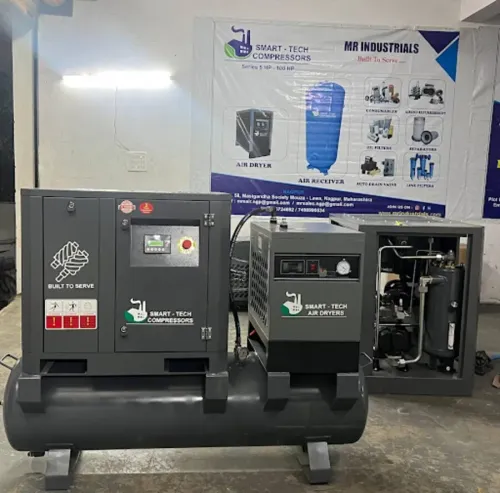
Check cycling after installation. Too little storage causes rapid load and unload changes; excessive storage can hide a control problem and delay recovery. Judge a tank-mounted compressor package by compressor FAD, receiver volume, pressure limits, control settings, and peak-duration capability together. Ask for the usable-storage calculation, not merely the tank volume.
Require a Site-Specific Selection and Verification From the Manufacturer
A reliable purchase specification begins with compressor manufacturer capacity matching, not a motor rating. Give the supplier your logged FAD demand, peak duration, required point-of-use pressure, ISO 8573-1 air-quality class, receiver pressures, shift schedule, leak estimate, future load, and control sequence.
Require a site-specific compressor selection using FAD at the actual discharge pressure and corrected site conditions. Apply altitude correction and high-inlet-temperature correction: reduced air density lowers mass flow, while hot air reduces cooling margin. A sea-level, standard-temperature catalogue rating can therefore miss the required FAD at your plant.
Ask the manufacturer to state these assumptions in writing:
- Compressor, dryer, filters, drains, receiver, and piping pressure losses
- Dryer inlet pressure, inlet-air temperature, ambient or cooling-water temperature, pressure dew point, and allowable pressure drop
- Whether the arrangement uses base-load compressors, a trim VFD, local storage, or another combination
| Arrangement | Supplier must demonstrate | Best fit |
|---|---|---|
| Base-load plus trim VFD | Stable base output and trim range across measured demand | Variable shifts and changing production |
| Fixed-speed machines with sequencing | Load, unload, minimum-run, and start limits | Steady demand with defined peaks |
| Local receiver storage | Usable volume between stated receiver pressures and recovery time | Short bursts, not sustained excess flow |
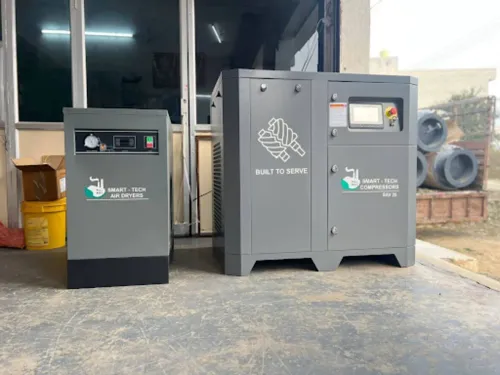
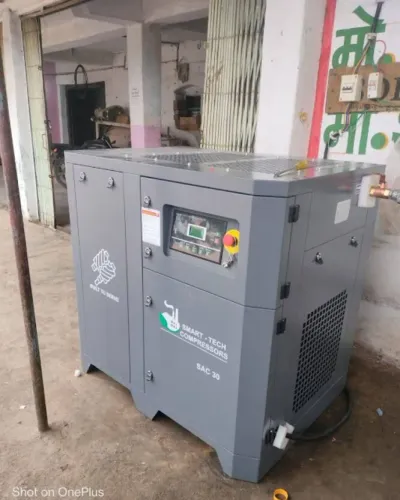
Require a commissioning performance test during real production. Record delivered flow, header pressure, motor loading, load and unload times, dryer pressure drop, dew point, and receiver recovery. SMART - TECH COMPRESSORS belongs in the comparison when it sizes equipment from those records rather than horsepower alone.
Related products
 | Tank Mounted 10HP TANK MOUNTED MODEL FOR PACKAGING INDUSTRIES Tank mounted complete package rotary screw air compressor specially built for small industries with affordable prices and service. |
 | Rotary Screw Air Compressor Smart -Tech Compressors Upto 300 HP We brought Special customised machine for customers , very cost effective and breakdown free , long life with energy saving and low maintenance... |
Frequently asked questions
How do you calculate compressor capacity from plant demand?
Log system flow, header and receiver pressure, compressor loading and unloading, and simultaneous machine operation at 1–5 minute intervals. Use the measured peak, average, and minimum demand profile rather than adding every machine nameplate.
How should pressure losses affect compressor selection?
Set the required working pressure after accounting for losses through filters, dryers, separators, pipework, valves, hoses, and elevation. The compressor must deliver the required pressure at the point of use, not only at its outlet.
When should you choose a fixed-speed or VFD compressor?
Use the logged load profile. Fixed-speed machines suit stable demand, while VFD compressors suit substantial and frequent flow variation. Sequencing controls coordinate multiple compressors and prevent inefficient overlap.
Can a receiver tank cover short air-demand peaks?
Yes, when the peak is brief and the receiver is correctly sized for pressure range, flow, and cycle frequency. Confirm the receiver volume and operating pressure instead of increasing compressor capacity for every temporary surge.
Related products
 | Rotary Screw Air Compressor Smart -Tech Make 30 HP Fix Speed Compressor ₹310000 Smart -Tech compressors braught a customised machine for customers very good in Quality , low cost , energy saving , low maintenance cost , fast... |
 | Rotary Screw Air Compressor SMART -TECH MAKE 25 HP VFD COMPRESSOR ₹380000 Smart -Tech compressors braught a customised machine for customers very good in Quality , low cost , energy saving , low maintenance cost , fast... |
 | Rotary Screw Air Compressors braught a customised machine for customers very good in Quality , low cost , energy saving , low maintenance cost , fast service availability , and 5... View product → |
 | Rotary Screw Air Compressor 50HP SMART -TECH VFD COMPRESSOR PREMIUM MODEL PREMIUM RANGE ROTARY SCREW AIR COMPRESSOR 50HP VFD MODEL WITH VERY AFFORDABLE PRICE AND MORE WARRANTY THAN ANY BRAND |